
HUAQING


Email: huaqingwj@21cn.com


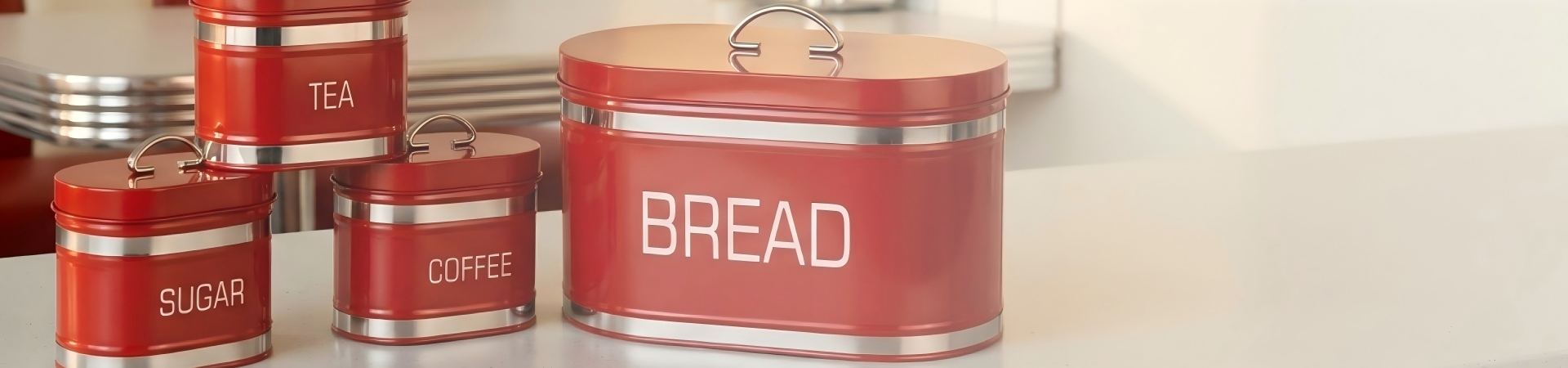
The best material for kitchen canisters depends on storage purpose, retail positioning, customization needs, and export market requirements. For dry food storage such as coffee, sugar, tea, flour, snacks, and pet treats, metal is often a strong choice because it combines stable structure, good shelf appearance, flexible color options, and efficient bulk production.
Common kitchen canister materials include metal, glass, ceramic, plastic, and bamboo. Each material has its own market position, but metal canisters are especially suitable for OEM and ODM Kitchen Storage projects because they can be produced in different sizes, shapes, colors, printed patterns, and matching sets.
| Material | Main Advantage | Sourcing Concern |
|---|---|---|
| Metal | Strong structure and flexible design | Coating quality must be controlled |
| Glass | Clear visibility | Heavy and fragile |
| Ceramic | Decorative look | Higher breakage risk |
| Plastic | Lower cost | Lower premium value |
| Bamboo | Natural style | Moisture control needed |
For export markets, food-contact safety is a key point. FDA guidance notes that substances used in food-contact applications must be suitable for intended use. EU Regulation EC 1935/2004 also requires food contact materials to be safe and not transfer substances in harmful amounts. This means kitchen canisters should use appropriate coatings, inks, inner surfaces, and packaging protection.
From a manufacturer vs trader perspective, direct factory cooperation gives better control over material thickness, coating adhesion, lid fitting, printing accuracy, color consistency, and carton strength. A trader may offer many product images, but the manufacturer controls the real production process and quality checkpoints.
Huaqing focuses on metal Houseware manufacturing, including kitchen Canister Sets, bread bins, storage tins, pet food bins, and customized metal household products. For OEM ODM orders, buyers can confirm size, capacity, lid style, color card, logo method, surface finish, packaging structure, and matching product range before bulk supply.
A standard metal kitchen canister manufacturing process includes sheet cutting, forming, edge treatment, surface cleaning, powder coating, printing, assembly, inspection, and carton packing. Important quality control checkpoints include surface scratches, coating adhesion, lid tightness, inner cleanliness, color matching, barcode labels, and drop-test packaging.
Before starting a project, prepare a sourcing checklist: target market, food-contact requirement, order quantity, canister size, set combination, Pantone color, logo artwork, packing method, test request, and delivery schedule. With stable manufacturing support, metal kitchen canisters can offer both practical storage value and stronger retail presentation.