
HUAQING


Email: huaqingwj@21cn.com


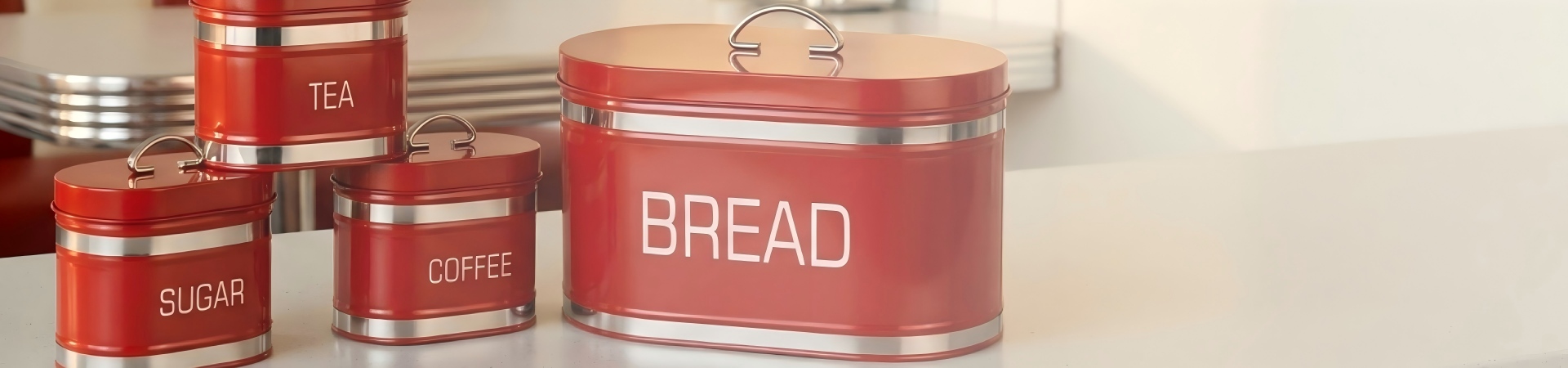
Square storage canisters generally save more space because their straight sides allow efficient countertop and shelf arrangement. Round canisters offer easier handling and a softer appearance, but leave unused gaps when placed side by side. The better choice depends on storage layout and product requirements.
Round storage canisters have cylindrical bodies, while square canisters feature four straight sides that create a more regular footprint. Both designs can store dry ingredients and kitchen essentials, but their shapes affect space utilization, capacity, manufacturing and retail presentation.
For kitchenware importers, wholesalers and private-label brands, the key consideration is not simply which shape looks better. It is how efficiently the canisters fit into real storage spaces and how well their design matches customer preferences.
| Comparison Factor | Round Storage Canister | Square Storage Canister |
|---|---|---|
| Space utilization | Leaves gaps when arranged in rows | Uses rectangular storage areas more efficiently |
| Shelf arrangement | Requires more planning to minimize unused space | Fits closely together on shelves |
| Countertop layout | Creates a softer, less rigid appearance | Creates a neat, aligned arrangement |
| Internal corners | No corners, making interior access straightforward | Corners may affect access depending on opening size |
| Handling | Curved body can feel comfortable to grip | Flat sides can provide stable handling surfaces |
| Visual style | Classic, soft and familiar | Modern, structured and organized |
| Manufacturing | Cylindrical forming may suit established production processes | Requires accurate corner forming and dimensional control |
| Best suited for | Flexible placement and traditional kitchen collections | Space-efficient storage and coordinated product sets |
The actual space savings depend on the canisters' dimensions, wall thickness, lid design and arrangement. A well-designed round canister may still use space efficiently, while an oversized square canister may be less practical than a smaller cylindrical model.
Square storage canisters generally use shelf and countertop space more efficiently because their flat sides can sit close together without leaving large curved gaps.
Their main advantages include:
Efficient shelf arrangement: Straight sides allow canisters to be placed in compact rows.
Better use of rectangular spaces: Square footprints align naturally with most shelves, drawers and cabinet interiors.
Consistent spacing: Matching products can be arranged with minimal gaps between adjacent containers.
Organized appearance: Uniform rows can create a coordinated Kitchen Storage display.
Practical product grouping: Different sizes can be arranged together while maintaining a consistent visual layout.
For example, a retailer selling metal canisters for coffee, tea, sugar and other dry ingredients may prefer square models for a coordinated countertop collection. The straight sides make it easier for customers to place several containers together.
However, space efficiency should be evaluated using actual dimensions rather than shape alone. The lid, handle, opening mechanism and required clearance can affect how closely products can be arranged.
Round storage canisters remain a useful choice when handling comfort, traditional styling and straightforward interior access are important.
Their advantages include:
Easy interior access: The absence of corners can make scooping and wiping the inside more straightforward.
Familiar appearance: Cylindrical containers suit traditional, classic and contemporary kitchen designs.
Comfortable handling: Curved bodies can be easy to grip, depending on their diameter and surface finish.
Flexible placement: Individual canisters can be positioned in different directions without creating a strong geometric layout.
Distinctive product styling: Round shapes can complement Bread Boxes, kettles and other kitchen accessories with curved forms.
For a brand targeting consumers who prefer classic kitchenware, round metal canisters may offer stronger visual appeal than a highly structured square collection.
The main trade-off is the unused space that can appear between adjacent cylinders. This matters most when multiple canisters need to fit within a limited shelf or countertop area.
Square canisters often provide more usable volume within the same rectangular footprint, but the exact difference depends on the dimensions and internal construction.
For a simplified comparison, consider a round canister with an internal diameter of 10 cm and an internal height of 15 cm.
Its approximate internal volume is:
[ V=\pi r^2h ]
[ V=\pi \times 5^2 \times 15\approx1,178\text{ cm}^3 ]
A square canister with an internal width and depth of 10 cm and the same internal height of 15 cm has an approximate volume of:
[ V=10\times10\times15=1,500\text{ cm}^3 ]
Under these simplified assumptions, the square canister offers approximately 27% more internal volume.
These figures are illustrative, not specifications for any particular product. Actual capacity depends on internal dimensions, corner radius, wall thickness, lid construction and usable filling space.
For B2B buyers, comparing internal capacity against external footprint is more useful than comparing shape labels alone.
Square storage canisters are generally more suitable for small kitchens where countertop and shelf space are limited.
Their straight sides allow them to sit close together, helping reduce gaps between containers. This is particularly useful when several products need to share a narrow countertop or cabinet shelf.
Round canisters may still be preferable when customers use only one or two containers, move them frequently or prioritize comfortable handling over compact arrangement.
When selecting products for small kitchens, importers should evaluate:
External width, depth and height
Internal storage capacity
Space required to open the lid
Handle or knob clearance
Shelf depth and countertop dimensions
Whether multiple sizes can be arranged together
For retailers, these practical dimensions can also become useful selling points because they explain how a product fits into everyday kitchen layouts.
Neither shape is universally easier or cheaper to manufacture. Production efficiency depends on the forming method, tooling, material thickness, equipment and required finish.
Round metal canisters may be suitable for established cylindrical forming processes. Square canisters require controlled corner geometry and accurate dimensional consistency to maintain a uniform appearance and proper lid fit.
| Manufacturing Factor | Round Canister | Square Canister |
|---|---|---|
| Body forming | May suit cylindrical forming processes | Requires forming and controlling flat sides and corners |
| Dimensional control | Focuses on diameter, height and roundness | Focuses on width, depth, corner geometry and squareness |
| Lid fit | Requires consistent circular dimensions | Requires accurate alignment with the rectangular opening |
| Surface finishing | Curved surfaces require consistent coating coverage | Corners and edges need appropriate coating coverage |
| Packaging | May leave gaps when packed together | May allow efficient carton arrangement |
| Quality inspection | Checks roundness, seams and opening dimensions | Checks squareness, corners, seams and lid alignment |
For mass production, the most suitable design is the one that meets customer requirements while maintaining stable quality and competitive total cost.
Manufacturers should evaluate samples and production feasibility before committing to large orders, particularly when square designs involve complex corners, decorative edges or customized lids.
Both round and square canisters support OEM and private-label development. The best shape depends on brand positioning, storage requirements and the intended retail market.
Square canisters are often suitable for brands emphasizing space-efficient organization and coordinated product sets. Round canisters can suit collections emphasizing classic styling, approachable shapes and easy interior access.
Depending on manufacturing capabilities, customization may include:
Body dimensions and storage capacity
Metal type and material thickness
Lid shape and opening mechanism
Powder-coated colors and surface finishes
Logo placement and decorative details
Coordinated sizes for coffee, tea, sugar and other storage needs
Retail packaging and product labeling
For private-label projects, buyers should confirm both internal capacity and external dimensions. A canister that looks compact may have limited usable space, while a larger exterior may not translate into proportionally greater capacity.
Before mass production, approve a sample and document dimensions, material specifications, finish requirements and quality acceptance criteria.
Importers should begin with the intended application rather than selecting a shape based only on appearance.
Square canisters are generally a strong option for space-conscious kitchen storage collections. Round canisters can be more suitable when traditional styling, individual placement or easy interior access is the priority.
A practical selection process includes:
Measure the intended storage area: Check shelf depth, countertop width and available height.
Compare usable capacity: Review internal dimensions rather than relying on external size alone.
Assess customer preferences: Consider the kitchen styles and price ranges of the target market.
Review manufacturing costs: Compare material use, tooling, finishing and packaging requirements.
Check product functionality: Evaluate lid fit, opening clearance and ease of cleaning.
Plan the assortment: Determine whether a single shape or a combination of round and square models best serves customers.
For new product lines, testing different shapes and sizes in controlled quantities can provide useful sales evidence before larger purchasing commitments.
HUAQING specializes in metal homeware manufacturing, including metal kitchen storage products and customized household items for international markets.
For importers, wholesalers, retailers and private-label brands, project discussions can cover canister dimensions, capacity, body structure, surface finishes, colors, branding and packaging, subject to manufacturing capabilities and project requirements.
Before placing a bulk order, buyers should confirm available shapes and sizes, customization options, material specifications, minimum order requirements and quality inspection procedures.
Contact HUAQING to discuss your metal storage canister requirements and develop a product range suited to your target market and storage needs.
Generally, yes. Square canisters can sit close together and use rectangular shelf space efficiently. Actual savings depend on product dimensions and arrangement.
No. Capacity depends on internal dimensions and construction. A square canister may hold more than a round model with a similar footprint, but specific dimensions must be compared.
Their smooth interiors have no corners, which can simplify wiping and scooping. However, cleaning also depends on the opening size, surface finish and lid design.
Square canisters may suit space-efficient storage collections, while round canisters may suit traditional designs. The best option depends on customer demand, manufacturing costs and product specifications.
Yes, depending on manufacturing capabilities. Customization may include dimensions, capacity, materials, finishes, lids, branding and packaging.