
HUAQING


Email: huaqingwj@21cn.com


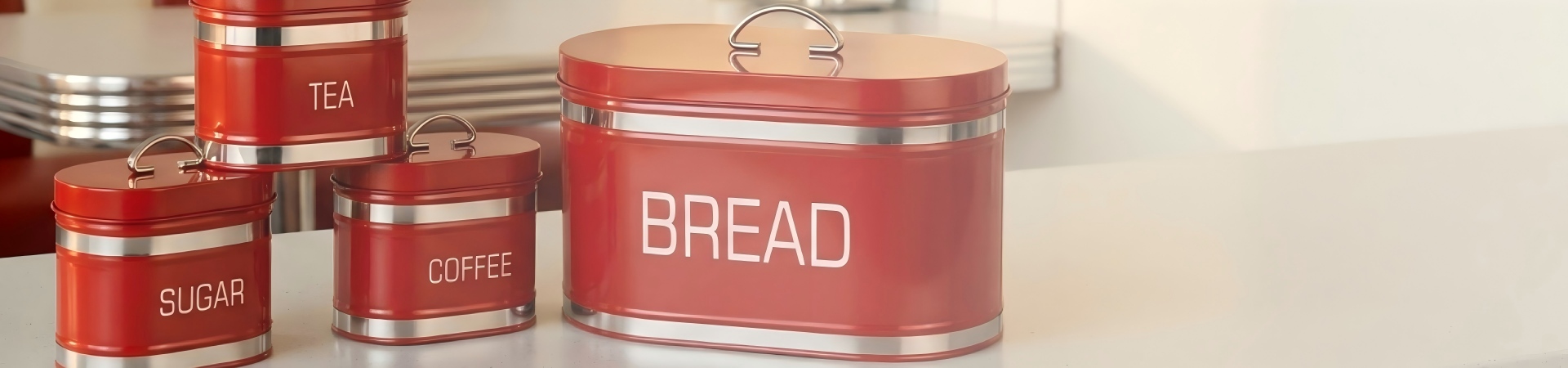
Metal storage canisters offer durability, light protection and flexible exterior customization, while glass storage jars provide visibility and a clear view of contents. For kitchen brands, the better choice depends on storage needs, target customers, product positioning and retail requirements.
Metal storage canisters are commonly made from stainless steel or coated carbon steel, while glass storage jars use transparent or tinted glass bodies, often paired with metal, plastic or silicone lids and seals.
For kitchenware importers, wholesalers, retailers and private-label brands, the material choice affects product durability, visibility, packaging, shipping costs and customization options.
| Comparison Factor | Metal Storage Canister | Glass Storage Jar |
|---|---|---|
| Main material | Stainless steel or coated carbon steel | Glass, sometimes combined with other materials |
| Visibility | Usually conceals the contents | Transparent glass allows contents to be seen |
| Light protection | Opaque metal blocks light | Clear glass allows light through |
| Impact resistance | Metal bodies generally resist shattering | Glass can crack or break if dropped |
| Weight | Often lighter than comparable thick glass designs, depending on construction | Can be relatively heavy |
| Cleaning | Smooth metal surfaces are generally easy to wipe | Glass bodies are often easy to clean when accessible |
| Design flexibility | Supports powder coating, printing and various metal finishes | Supports clear, tinted, textured or decorative glass |
| Branding options | Offers broad exterior branding and color customization | Labels, printing and lid customization are common options |
| Shipping considerations | May be less vulnerable to breakage | Requires suitable protective packaging |
| Best suited for | Durable, opaque and coordinated Kitchen Storage collections | Visible ingredient storage and display-oriented collections |
Neither material is universally superior. The right option depends on what the product needs to store, how customers use it and how the brand plans to position it.
Metal storage canisters appeal to brands that prioritize durability, coordinated product styling and flexible exterior customization.
Their main advantages include:
Resistance to shattering: Metal bodies do not break like glass when dropped, although they can dent or deform.
Light protection: Opaque metal protects light-sensitive contents from direct light exposure.
Flexible finishes: Powder coating, brushed surfaces and other finishing options support different design concepts.
Coordinated collections: Canisters can be matched with metal Bread Boxes, Utensil Holders and other kitchen accessories.
Practical exterior branding: Logos, printed graphics and color schemes can help establish a recognizable product identity.
For example, a private-label kitchenware brand may develop matching metal canisters for coffee, tea, sugar and other dry ingredients. Coordinated colors and finishes can create a consistent appearance across the collection.
However, metal is not automatically suitable for every storage application. The material, interior finish, lid design and sealing performance must match the intended contents and storage conditions.
Glass storage jars appeal to consumers who want to see their ingredients without opening the container.
Their main advantages include:
Visible contents: Transparent walls make it easier to identify stored ingredients and estimate remaining quantities.
Display value: Glass can showcase colorful ingredients, grains, spices and other dry goods.
Neutral appearance: Clear glass can complement different kitchen styles without introducing a strong exterior color.
Cleaning visibility: Users can inspect the interior for residue or remaining particles.
Versatile presentation: Glass jars can be arranged on open shelves or countertops as part of a kitchen display.
For retailers, glass jars can be particularly attractive for product ranges that emphasize visible organization and ingredient presentation.
However, glass can break if dropped or struck, and larger jars may be heavy. Packaging and transportation also require attention because damage during handling can increase replacement costs.
The better material depends on the ingredient and the complete container design, not simply whether the body is metal or glass.
Metal canisters block light, making them useful for contents that benefit from reduced light exposure. Glass jars allow users to see the contents, but clear glass provides little protection from visible light.
For both materials, moisture control and freshness depend heavily on the lid and seal.
Important considerations include:
Airtightness: A well-designed lid and seal help limit moisture exchange and air exposure.
Light sensitivity: Opaque metal provides an advantage for ingredients that need protection from light.
Moisture exposure: The container and closure should suit the storage environment.
Material compatibility: The body, interior surface and seal should be appropriate for the intended contents.
Cleaning and drying: Containers should be cleaned and dried properly before refilling.
For coffee, tea, spices and other dry ingredients, buyers should evaluate the entire storage system. A metal canister with a poorly fitting lid may protect contents less effectively than a glass jar with a reliable airtight seal.
Neither material alone guarantees longer freshness.
Metal storage canisters generally offer better resistance to breakage, while glass jars provide a rigid body that can remain in good condition for years when handled carefully.
The main durability differences include:
Impact resistance: Metal can dent, but it does not shatter like glass.
Surface condition: Metal finishes may scratch or chip, while glass may develop chips or cracks.
Structural stability: Metal thickness, body geometry and seam construction influence resistance to deformation.
Closure durability: Hinges, lids and seals can wear out on either type.
Handling conditions: Repeated movement, accidental drops and transport conditions affect service life.
For kitchenware brands, the most useful assessment combines material inspection with functional testing. Canister bodies, jar openings, lids and seals should all be evaluated before mass production.
A durable container must also remain practical to use. A metal canister that dents easily or a glass jar with a poorly designed lid may generate customer complaints despite the material's inherent strengths.
Both metal canisters and glass jars can be easy to clean, provided their openings, interior surfaces and lids are designed for convenient access.
Glass makes it easier to inspect the interior, while smooth metal surfaces are generally straightforward to wipe clean.
Maintenance depends on several factors:
Whether the opening is wide enough for thorough cleaning
Whether the lid and seal can be removed
Whether corners or seams trap residue
Whether the material is compatible with the intended cleaning method
Whether the container can be dried completely before reuse
Metal canisters with narrow openings may be difficult to clean internally, while glass jars with complex lid assemblies may require extra attention around the seal.
For B2B buyers, cleaning accessibility should be evaluated alongside appearance and durability, particularly when the product is intended for repeated food storage.
Metal storage canisters generally offer more opportunities for opaque exterior customization, while glass jars provide strong visual merchandising potential through transparent walls.
Depending on manufacturing capabilities, options may include:
Custom powder-coated colors
Matte, glossy or textured finishes
Printed or applied logos
Embossed or decorative exterior details
Different body shapes and dimensions
Coordinated lids and retail packaging
These options can help private-label brands create consistent kitchen storage collections.
Potential options include:
Clear or tinted glass
Different jar shapes and capacities
Printed graphics or labels
Customized lids and closures
Decorative textures
Branded packaging
Glass jars may be preferable when visible ingredients are central to the product concept. Metal canisters may be better when exterior colors, opaque storage and coordinated finishes are the main selling points.
Cost-effectiveness depends on the product specification, order quantity, packaging requirements and expected market demand.
Metal canisters may offer advantages in breakage resistance and exterior customization. Glass jars may provide strong product visibility but require protective packaging and careful transport handling.
| Cost Consideration | Metal Storage Canister | Glass Storage Jar |
|---|---|---|
| Material cost | Depends on metal type, thickness and finish | Depends on glass type, dimensions and production method |
| Finishing | May require coating, polishing or printing | May require tinting, printing or decorative treatment |
| Packaging | Protection against scratches and dents | Protection against breakage and impact |
| Shipping | Weight and carton utilization depend on design | Weight and breakage protection can affect freight costs |
| Replacement risk | Dents or coating damage may require replacement | Breakage may result in product loss |
| Branding | Broad exterior customization options | Visibility and label or lid customization options |
For importers, the correct comparison should include landed cost, packaging, freight, expected damage rates and replacement expenses rather than unit price alone.
The most economical product is the one that meets customer expectations while maintaining an acceptable total cost and profit margin.
Both metal canisters and glass jars can support OEM and private-label development. The best choice depends on the target market, product function and desired brand identity.
Metal canisters are often suitable for coordinated kitchen storage collections that emphasize durable bodies, opaque storage and customized finishes.
Glass jars are suitable for products where visibility, ingredient presentation and transparent storage are priorities.
Before mass production, buyers should define:
Container dimensions and usable capacity
Body material and thickness, where applicable
Lid structure and sealing requirements
Surface finish, color or transparency
Logo placement and packaging specifications
Quality inspection and acceptance criteria
For metal products, particular attention should be given to coating consistency, body deformation and lid fit. For glass products, buyers should inspect cracks, chips, dimensional consistency and packaging protection.
Sample approval helps ensure that the final product matches the intended retail positioning.
HUAQING specializes in metal homeware manufacturing, including metal kitchen storage products and customized household items for international markets.
For importers, wholesalers, retailers and private-label brands, project discussions can cover canister dimensions, metal specifications, surface finishes, colors, branding and packaging, subject to manufacturing capabilities and project requirements.
Before placing a bulk order, buyers should confirm available designs, customization options, material specifications, minimum order requirements and quality inspection procedures.
Contact HUAQING to discuss your metal storage canister requirements and develop a kitchen storage collection suited to your target market.
Metal canisters generally offer better resistance to breakage and block light, while glass jars provide visibility and display value. The better choice depends on the stored contents and intended use.
Glass jars allow users to see the contents, but clear glass does not block light. Opaque metal canisters may be preferable for light-sensitive ingredients when paired with a suitable lid and seal.
Not automatically. Freshness depends on the ingredient, lid seal, moisture exposure, temperature and storage conditions. The container's material alone does not determine freshness.
Yes. Depending on manufacturing capabilities, metal canisters can support customized dimensions, colors, surface finishes, logos and packaging.
Importers should verify material specifications, capacity, lid fit, sealing performance, finish quality, cleaning accessibility, packaging protection and final inspection standards.